

German Light Lager

Introduction
If you're looking for a light refreshing beer that's a thirst quencher, this is it! Perfect after a few laps with the lawnmower.
This is a scaled back version of our Premium Lager, with the following changes:
- Brewed to only 4% ABV (instead of 5% ABV)
- Approximately half the bitterness (9 IBU instead of 19 IBU)
- Brewed with soft, low mineral water (close to distilled / reverse osmosis) to help smooth out what little bitterness there is
- An even longer multi-step mash schedule to help increase attenuation resulting in a very dry, thirst quenching beer
Like our Premium Lager this beer still uses all German ingredients, including our favourite Weyermann pilsner malt which provides a clean, slightly malty backbone with a subtle almost honey-like flavour. It's considered by many as the premium German pilsner malt that all others are compared to.
While the recipe is deceptively simple (there's only one malt and a single hop addition), please keep in mind that very low flavour lagers such as this one are more difficult to brew correctly as that there's nothing for flaws to hide behind. To create your perfect German Light Lager it's important to use fresh ingredients and follow our Notes / Process section below closely. This includes using very soft water, boiling hard, chilling quickly, oxygenating well, pitching the recommended amount of yeast into cold wort, fermenting slow & cold, limiting oxygen contact after fermentation is complete, and then conditioning at least a month near freezing before serving. Your patience and attention to detail will reward you.
Brew up a batch and let us know how you like it!

German Light Lager
Size: 12 US gallons (post-boil @ 68F)
Mash Efficiency: 95%
Attenuation: 89%
Calories: 111 kcal per 12 fl oz
Original Gravity: 1.035 (style range: 1.028 - 1.040)
Final Gravity: 1.004 (style range: 0.998 - 1.008)
Colour: 2.2 SRM (style range: 2 - 3)
Alcohol: 4% ABV (style range: 2.8% - 4.2%)
Bitterness: 9 IBU (style range: 8 - 12)
Mash:
12.9 lb German pilsner malt (1.5-2.1L) (100%)
Boil:
2 oz German Hallertau Mittelfruh hops (2.9%) - added during boil, boiled 60 min [9 IBU]
1 Whirlfloc tablet (Irish moss) - added during boil, boiled 15 min
Yeast:
Fermentis Saflager W-34/70 dry yeast* (58g recommended or make an equivalent starter)
*If you prefer to use liquid yeast, Wyeast 2124 Bohemian Lager or White Labs WLP830 German Lager are said to be the equivalent Weihenstephan sourced strains. You'll need ~598 billion cells or an equivalent starter.
Purchasing through our affiliate links helps support our site at no extra cost to you. We thank you!
Notes / Process
- Add 500mg potassium metabisulfite to 20 gallons water to remove chlorine / chloramine (if required).
- Water treated with brewing salts to our Soft flavour profile: Ca=21, Mg=5, Na=18, Cl=16, SO4=21 (Randy Mosher's ideal Pale Lager numbers. Just enough to acidify the mash while keeping the water soft). While hard water accentuates up-front hop-bitterness, soft water suppresses it. Because of the soft water, the bitterness is rounded, not rough. If your water is high in minerals, try cutting it with reverse osmosis (or distilled) water to reach the target numbers above. For example, using 50% reverse osmosis (or distilled) water reduces the mineral counts by half. For more information on how to adjust your water, refer to our step by step Water Adjustment guide.
- 2.0 qt/lb mash thickness.
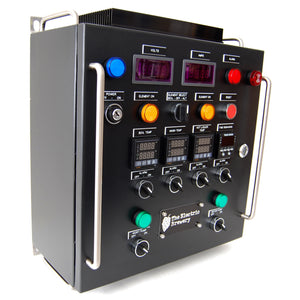
- Start the mash at 120F (low end of the protein rest range) and immediately start raising to 145F (beta rest) and hold for 180 minutes.
- Ramp up to 159F and hold for 60 mins (alpha rest).
- Raise to 168F mashout temperature and hold for 10 mins.
- ~90 min fly sparge with ~5.6-5.8 pH water (measured at mash temperature).
- Boil hard for 90 minutes, adding hops per schedule. Lid on at flameout, start chilling immediately.
- Cool the wort quickly to 50F (we use a one-pass convoluted counterflow chiller to quickly lock in hop flavour and aroma) and transfer to fermenter.
- Oxygenate the chilled wort to a level of 14 ppm dissolved oxygen. For more information refer to our Aerating / Oxygenating Wort guide.
- Pitch yeast and ferment at 50F (wort temperature). We use modified stainless fermenting buckets in wine fridges.
- Ferment until approximately 5 points from final gravity and then raise the temperature to 72F until finished. In our case we simply turn off the fermenting fridges and allow the beer to naturally rise to room temperature. Assume fermentation is done if the gravity does not change over ~3 days.
- Before packaging you may optionally rack to a brite tank (we use 5 gallon glass carboys) that has been purged with CO2 to avoid oxygen pickup, add 1 tsp of unflavoured gelatin dissolved in a cup of hot distilled water per 5 gallons of beer, and allow to clear for 2-3 days. In most cases we recommend skipping this step as the less you handle the beer and potentially expose it to oxygen, the better. The beer will drop brilliantly clear on its own during the conditioning period.
- Package as you would normally. We rack to kegs that have first been purged with CO2 and then chill to near freezing while carbonating at the same time in a 6-keg conditioning fridge. After ~1-2 weeks at serving pressure the kegs will be carbonated and ready to serve. In a hurry? Feel free to raise the CO2 pressure temporarily to 30-40 PSI to carbonate fast over a 24 hour period, and then turn back down to serving pressure.
- Carbonate this beer to higher than normal levels, around 2.5 to 3.5 volumes of CO2.
- This beer will improve greatly if conditioned just above freezing for at least 4 weeks before serving (6-8 weeks is better). Avoid keeping the beer unrefrigerated for extended periods. It will remain clean and crisp for months if kept near freezing.
For detailed brewing instructions, see our Brew Day Step by Step guide.
Enjoy!

Pictures / Videos
Interested in seeing what we're brewing right now? Follow us on Instagram for pictures and videos of our brewing activities as they happen.
