

Hopfenweisse

Introduction
Not an official BJCP style, Hopfenweisse was first brewed in 2007/2008 as a collaboration between the German brewery Schneider & Sohn and America's Brooklyn Brewery. Long time friends, the two brewmasters (Hans-Peter Drexler and Garrett Oliver) agreed to brew essentially the same pale traditional Weizen in the other's brewery, brewed to Weizenbock strength but with different hopping to reflect the local hop flavours. The result was two versions of a hoppy yet balanced wheat beer that combined the typical Weizen banana and clove notes with newer hop flavours.
The beer brewed at the Schneider & Sohn German brewery by Oliver featured German Hallertau Tradition and German Hallertau Saphir hops, while the American Brooklyn Brewery version brewed by Drexler featured Amarillo and Palisade hops. Even though the alcohol level is high (8.2% ABV), kettle and dry hop levels are kept restrained in order to maintain a balance between the yeast derived esters and hop flavours. The goal wasn't to make a Weizen IPA. For this same reason a balanced water profile is used that does not favour maltiness or bitterness.
We present both versions of the beer here with the only difference being the hop bill. Feel free to brew whichever version you prefer. The Schneider & Sohn version with German hops tends to push more spicy and citrus flavours while the Brooklyn Brewery version with American hops has a more pronounced tropical fruit profile.
Both versions use all German malt with a 50:50 split between pilsner and wheat. For German malts we prefer Weyermann brand so that's what was used here. Feel free to substitute if you like.
Using an authentic Weizen yeast is key as it gives the beer its unique banana/clove character so yeast substitutions are not recommended. This is typically either Wyeast 3068 Weihenstephan Weizen yeast or White Labs WLP300 Hefeweizen Ale yeast (purported to be the same strain, but after many years of using both we tend to favour WY3068). Fermented warmer the taste pushes towards banana, fermented cooler and the taste leans towards clove. We ferment on the colder side and manipulate the mash schedule and pH to adjust the flavour profile to our liking (more in our Notes / Process section below). This strain is quite unique and requires some special care. To quote Wyeast on the usage of WY3068:
The classic and most popular German wheat beer strain used worldwide. This yeast strain produces a beautiful and delicate balance of banana esters and clove phenolics. The balance can be manipulated towards ester production through increasing the fermentation temperature, increasing the wort density, and decreasing the pitch rate. Over pitching can result in a near complete loss of banana character. Decreasing the ester level will allow a higher clove character to be perceived. Sulfur is commonly produced, but will dissipate with conditioning. This strain is very powdery and will remain in suspension for an extended amount of time following attenuation. This is true top cropping yeast and requires fermenter headspace of 33%.
Heed the warning about headspace. You'll need a lot of room in your fermenter as this yeast strain develops a substantial krauzen (foam) during the first few days of fermentation. A blow-off tube is recommended as well. See our Fermenters guide for tips on this and what we do.
Jamil Zainasheff gives some good advice on the fermentation temperature for this yeast from his Brewing Classic Styles book which we follow: Ferment at 62F. It's just below the yeast's recommended 64-75F range but it works great and produces a really clean tasting beer with a nice balance of banana / clove flavours.
Some brewers prefer to underpitch this yeast and / or under-aerate to push ester production but it's not a practice we like to use with any of our beers as it can lead to slow starts, and stalls / incomplete fermentation. Our preference is to pitch a properly sized starter of healthy yeast and control the flavour through fermentation temperature and mash schedule / pH. Mash schedule, mash pH, water profile, choice of yeast, yeast pitch rate, aeration/oxygenation level, and fermentation temperature can all be played with to change the flavour outcome. If you prefer a Hopfenweisse with more yeast derived banana / clove flavours try lowering the pitch rate and / or level of oxygen. If you prefer more banana and less clove, skip the ferulic acid rest and ferment at a warmer 68F (wort temperature).
Brew up a batch and let us know how you like it!

Hopfenweisse (American Version)
Size: 12 US gallons (post-boil @ 68F)
Mash Efficiency: 95%
Attenuation: 81.5%
Calories: 253 kcal per 12 fl oz
Original Gravity: 1.076 (style range: N/A)
Final Gravity: 1.014 (style range: N/A)
Colour: 4.8 SRM (style range: N/A)
Alcohol: 8.2% ABV (style range: N/A)
Bitterness: 39 IBU (style range: N/A)
Mash:
14 lb German pilsner malt (1.5-2.4L) (50%)
14 lb Pale (or white) wheat malt (1.5-2.4L) (42.6%)
0.64 lb Rice hulls*
Boil:
1.5 oz Magnum hops (12%) - added during boil, boiled 60 min [28.1 IBU]
1 oz Amarillo hops (8.1%) - added during boil, boiled 15 min [6.1 IBU]
1 oz Palisade hops (7.0%) - added during boil, boiled 15 min [5.2 IBU]
1 Whirlfloc tablet (Irish moss) - added during boil, boiled 15 min
Post-boil:
2 oz Amarillo hops (8.1%) - added immediately after boil
2 oz Palisade hops (7.0%) - added immediately after boil
Yeast:
Wyeast 3068 Weihenstephan Weizen yeast or White Labs WLP300 Hefeweizen Ale yeast
(~837 billion cells or an equivalent starter)
Dry hop:
2 oz Amarillo hops (8.1%) - added to fermenter near end of fermentation, steeped 3 days
2 oz Palisade hops (7.0%) - added to fermenter near end of fermentation, steeped 3 days
*Wheat malt does not have a husk so the natural filter bed in the Mash / Lauter Tun is greatly reduced as the recipe is 50% wheat. Brewers with systems that are prone to stuck sparges should add rice hulls at a rate of about 20:1 huskless grain to rice hull ratio to avoid stuck sparges. We do not need to use rice hulls with our electric brewery setup. More information.
Purchasing through our affiliate links helps support our site at no extra cost to you. We thank you!

Hopfenweisse (German Version)
Size: 12 US gallons (post-boil @ 68F)
Mash Efficiency: 95%
Attenuation: 81.5%
Calories: 253 kcal per 12 fl oz
Original Gravity: 1.076 (style range: N/A)
Final Gravity: 1.014 (style range: N/A)
Colour: 4.8 SRM (style range: N/A)
Alcohol: 8.2% ABV (style range: N/A)
Bitterness: 39 IBU (style range: N/A)
Mash:
14 lb German pilsner malt (1.5-2.4L) (50%)
14 lb Pale (or white) wheat malt (1.5-2.4L) (42.6%)
0.64 lb Rice hulls*
Boil:
1.5 oz Magnum hops (12%) - added during boil, boiled 60 min [28.1 IBU]
1.5 oz German Hallertau Tradition hops (5.6%) - added during boil, boiled 15 min [6.3 IBU]
1.5 oz German Hallertau Saphir hops (4.5%) - added during boil, boiled 15 min [5.1 IBU]
1 Whirlfloc tablet (Irish moss) - added during boil, boiled 15 min
Post-boil:
2 oz German Hallertau Tradition hops (5.6%) - added immediately after boil
2 oz German Hallertau Saphir hops (4.5%) - added immediately after boil
Yeast:
Wyeast 3068 Weihenstephan Weizen yeast or White Labs WLP300 Hefeweizen Ale yeast
(~837 billion cells or an equivalent starter)
Dry hop:
2 oz German Hallertau Tradition hops (5.6%) - added to fermenter near end of fermentation, steeped 3 days
2 oz German Hallertau Saphir hops (4.5%) - added to fermenter near end of fermentation, steeped 3 days
*Wheat malt does not have a husk so the natural filter bed in the Mash / Lauter Tun is greatly reduced as the recipe is 50% wheat. Brewers with systems that are prone to stuck sparges should add rice hulls at a rate of about 20:1 huskless grain to rice hull ratio to avoid stuck sparges. We do not need to use rice hulls with our electric brewery setup. More information.
Purchasing through our affiliate links helps support our site at no extra cost to you. We thank you!
Notes / Process
- Add 500mg potassium metabisulfite to 20 gallons water to remove chlorine / chloramine (if required).
- Water treated with brewing salts to our Balanced flavour profile: Ca=50, Mg=10, Na=16, Cl=70, SO4=70 (Hit minimums on Ca and Mg, keep the Cl:SO4 ratio low and equal. Do not favour flavour / maltiness or bitterness / dryness. For balanced beers.). For more information on how to adjust your water, refer to our step by step Water Adjustment guide.
- 1.5 qt/lb mash thickness.
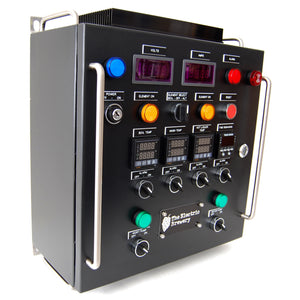
- Start the mash at 113F and hold for 15 mins (this is a ferulic acid rest which helps promote the creation of 4-vinyl guaiacol which has clove-like phenol flavours that Weizens are known for). This rest works best at a pH of 5.7-5.8 (relative to mash temperature) so if you add mash salts and acid you want to wait and do it after the ferulic acid rest.
- Ramp up to 131F and hold for 10 mins (high end of the protein rest range).
- Ramp up to 150F and hold for 90 mins (beta rest).
- Ramp up to 158F and hold for 30 mins (alpha rest).
- Raise to 168F mashout temperature and hold for 10 mins.
- ~90 min fly sparge with ~5.6-5.8 pH water (measured at mash temperature).
- Boil for 90 minutes, adding hops per schedule. Lid on at flameout, start chilling immediately. Some brewers choose not to add kettle finings during the boil (such as Whirlfloc) as the beer is supposed to be cloudy, but the cloudiness of this beer comes from the yeast. We still want to remove proteins, hot break material, and so forth.
- Cool the wort quickly to 62F (we use a one-pass convoluted counterflow chiller to quickly lock in hop flavour and aroma) and transfer to fermenter.
- Aerate or oxygenate the chilled wort to a level of 14 ppm dissolved oxygen. For more information refer to our Aerating / Oxygenating Wort guide.
- Pitch yeast and ferment at 62F (wort temperature). We use modified stainless fermenting buckets in wine fridges.
- Ferment until approximately 5 points from final gravity and then raise the temperature to 72F until finished. In our case we simply turn off the fermenting fridges and allow the beer to naturally rise to room temperature. Assume fermentation is done if the gravity does not change over ~3 days.
- We do not recommend using finings such as unflavoured gelatin as it helps keep as much yeast in suspension as possible.
- Package as you would normally. We rack to kegs that have first been purged with CO2 and then chill to near freezing while carbonating at the same time in a 6-keg conditioning fridge. After ~1-2 weeks at serving pressure the kegs will be carbonated and ready to serve. In a hurry? This beer is best served reasonably fresh so feel free to raise the CO2 pressure temporarily to 30-40 PSI to carbonate fast over a 24 hour period, and then turn back down to serving pressure.
- Carbonate this beer to higher than normal levels, around 2.5 to 3.5 volumes of CO2.
- If you keg, you will find that over time the beer naturally clears as the protein haze and yeast settles. You may occasionally jostle or flip the keg to stir up the sediment to re-introduce a cloudy appearance if you prefer.
For detailed brewing instructions, see our Brew Day Step by Step guide.
Enjoy!

Pictures / Videos
Interested in seeing what we're brewing right now? Follow us on Instagram for pictures and videos of our brewing activities as they happen.
